
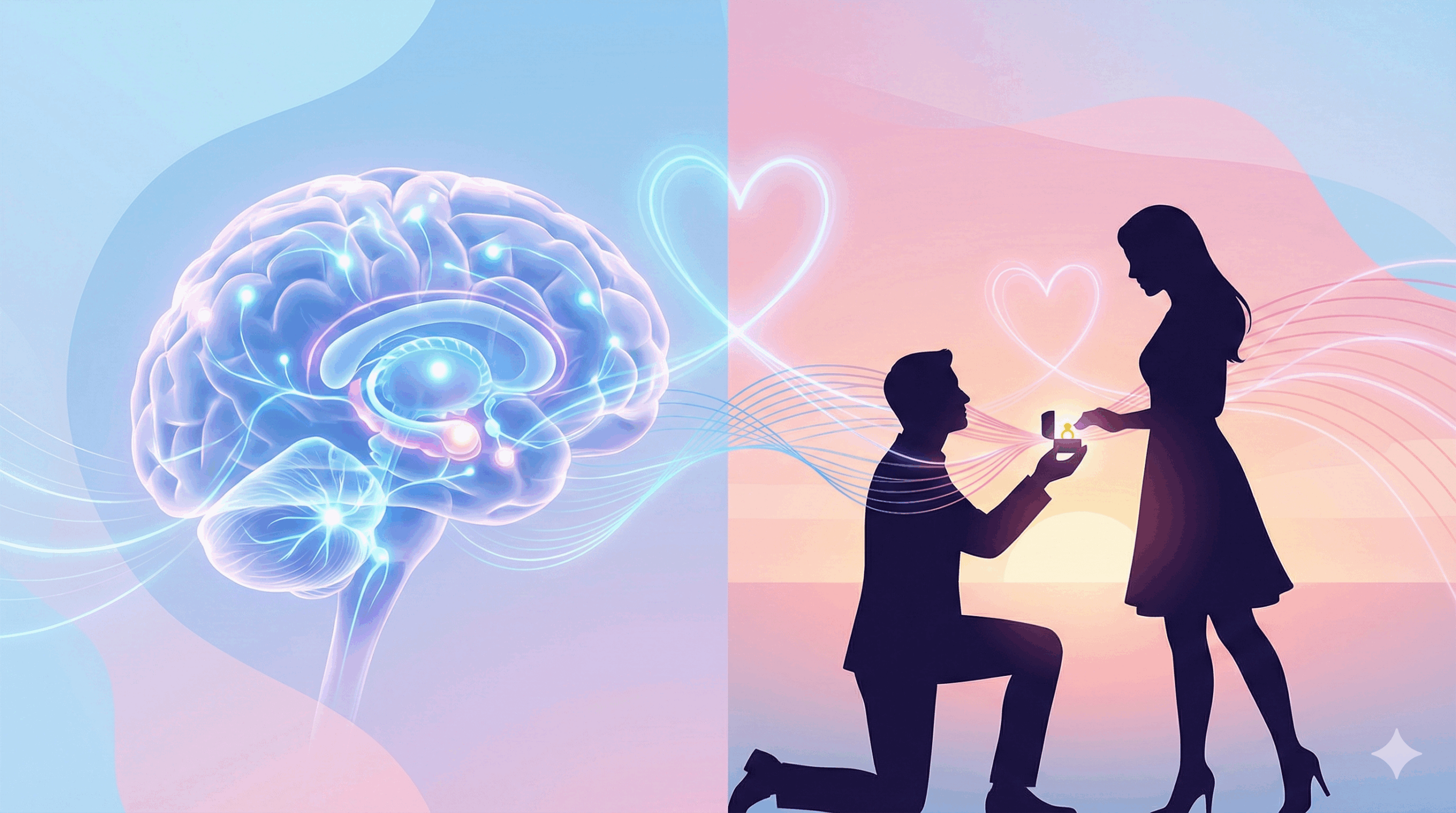
You’ve seen them. The Times Square proposal videos that rack up millions of views. The airport gate declarations that make strangers cry. The stadium jumbotron moments that become family legend.
Some people call them romantic. Others call them performative.
But here’s what psychology calls them: strategic commitment devices.
Public proposals aren’t just about the spectacle. They activate specific psychological mechanisms that private proposals simply can’t. When you drop to one knee in front of hundreds of strangers, you’re not just asking a question. You’re triggering a cascade of cognitive processes that fundamentally alter how both of you experience and remember this commitment.
The research is clear. The setting matters. The witnesses matter. The scale matters.
Let’s look at why.
The Commitment and Consistency Principle: Why Public Declarations Stick
When you make a promise in private, you answer to one person. When you make it public, you answer to everyone who witnessed it.
This isn’t just social pressure. It’s how your brain processes identity.
Research shows that public commitments create significantly stronger behavioral follow-through than private ones. The principle works through both personal and interpersonal pressures, with commitments that are active, public, effortful and freely chosen exerting the strongest influence on future behavior.
The numbers back this up. In one study, simply asking patients to write down their own appointment times reduced no-shows by 18%. Another found that homeowners who first agreed to display a small sign were 400% more likely to later accept a large billboard compared to those who received no initial request.
Your brain treats public declarations differently because consistency is seen as a desirable personality trait. It’s viewed as rational, assured, trustworthy and sound. Once you publicly commit, behavioral consistency becomes tied to your identity and how others perceive you.
The way you behave tells you about yourself. It becomes a primary source of information about your beliefs, values and attitudes.
This creates a self-reinforcing loop. Public declarations shape self-perception, which then drives consistent future behavior. The same psychology explains why public New Year’s resolutions succeed at higher rates than private ones—visibility creates accountability.
Peak-End Theory: How Your Brain Actually Remembers the Proposal
Here’s something most people don’t realize about memory: your brain doesn’t average experiences.
It snapshots them.
You judge experiences largely based on how you felt at the peak moment and at the end, rather than the total sum or average of every moment. A comprehensive 2022 meta-analysis found that the peak effect was large, the end effect was medium sized, and these effects were stronger than the effect of the duration of the experience, which was essentially nil.
Translation: a 30-second proposal in Times Square can create a more powerful memory than a 3-hour private dinner, depending on the emotional intensity of the peak moment.
The famous 1993 Kahneman study demonstrated this counterintuitively. Participants actually preferred repeating a longer painful experience because it ended better. They chose the long trial simply because they liked the memory of it better.
Vacation studies confirm this pattern. Remembered overall happiness was approximately predicted by the peak-end rule, while the duration of a vacation appeared to have negligible effects on remembered happiness.
For proposals, this means:
- The emotional peak matters more than the length of the setup
- The ending (the “yes” moment) disproportionately shapes the memory
- A high-intensity public setting creates stronger memory encoding than a longer, quieter private moment
Your brain doesn’t remember the proposal. It remembers how the proposal felt.
Social Proof: The Power of Witnessed Commitment
When you propose in public, you’re not just asking your partner. You’re demonstrating your commitment to everyone watching.
This activates social proof, a psychological phenomenon wherein people copy the actions of others in choosing how to behave in a given situation. It’s especially prevalent in ambiguous or unfamiliar conditions, or in big groups.
Robert Cialdini’s research demonstrates that people are especially likely to perform certain actions if they can relate to the people who performed the same actions before them. The effects are even more pronounced when the examples come from people the observer knows, such as friends and neighbors.
In hotel towel reuse studies, simply stating that “75% of our guests reuse their towels” increased compliance by 26%. The principle works because social proof is more powerful when being accurate is more important and when others are perceived as especially knowledgeable.
For proposals, witnesses serve three functions:
Validation. The crowd’s reaction confirms the appropriateness and significance of the moment.
Accountability. Public witnesses create social pressure to honor the commitment.
Amplification. The shared experience becomes part of your relationship story, reinforced every time someone mentions it.
The more public you make a commitment, the more you feel you have to be consistent, even if those judgments are later proved to be wrong. Making a commitment public increases follow-through likelihood by up to 65% because public commitments create social pressure to remain consistent in front of others.
The Vulnerability Premium: Why Public Risk Deepens Connection
Public proposals are risky. That’s not a bug. That’s the feature.
Clinical psychologist Sue Johnson’s research on attachment bonding demonstrates that responsiveness during moments of vulnerability strengthens emotional bonds and creates a sense of security in the relationship. Trust is fundamentally defined as a willingness to be vulnerable to another party, and vulnerability serves as a powerful catalyst for trust building.
When you propose publicly, you’re demonstrating vulnerability on multiple levels:
- Emotional exposure (your feelings are visible to strangers)
- Social risk (public rejection is possible)
- Identity investment (you’re publicly claiming this relationship as central to who you are)
Research shows that when both partners embrace vulnerability, they build a foundation of trust, emotional safety, and genuine connection. Harvard professor Jeff Polzer’s work on “vulnerability loops” shows that when one person communicates vulnerability and another reciprocates, increased trust will be established and your relationship will be deepened.
Studies confirm that sharing vulnerabilities can be therapeutic, offering relief from emotional burdens and reducing stress while creating emotional safety.
The public proposal becomes proof: “I was willing to risk everything in front of everyone because you’re worth it.”
Location Psychology: Why Times Square Hits Differently
Not all public proposals carry the same psychological weight.
The snapshot model of memory, proposed by Daniel Kahneman and Barbara Fredrickson, suggests we remember events using a representational heuristic, where specific moments, like snapshots from a vacation, shape our overall perception and assign meaning to the experience.
Research confirms that how individuals remember a certain experience is just as important as the experience itself. Emotions experienced during peak moments determine whether an individual will, going forward, value and recall the commitment.
Studies show that endings in particular have been found to significantly predict remembered overall valence and subsequent behavior, including whether participants would choose to repeat one experience over another or not.
Location factors that amplify psychological impact:
Scale. Larger venues create more dramatic peak moments. A Times Square billboard registers differently in memory than a restaurant proposal.
Iconicity. Culturally significant locations add meaning layers. You’re not just proposing. You’re proposing at Times Square. For couples considering this location, our guide to romantic Times Square experiences covers timing, venues, and the infrastructure that makes proposals work.
Sensory intensity. Bright lights, crowds, noise—all increase emotional arousal, which strengthens memory encoding.
Uniqueness. Distinctive settings create more retrievable memories. Your brain files “Times Square proposal” differently than “restaurant proposal number 47.”
The emotional arousal and valence of a location directly impact memory encoding through different brain structures. High-arousal, positive-valence locations create the strongest, most enduring memories.
The Cognitive Consistency Shortcut: Why Your Brain Defaults to Follow-Through
Behavioral consistency acts as a judgment heuristic to which we default in order to ease decision making. It’s easier to make one decision and stay consistent to it than to make a new decision every single time.
Research shows that once we have made a choice or taken a stand, we will encounter personal and interpersonal pressures to behave consistently with that commitment. The principle is so powerful that commitments are most effective in changing a person’s self-image and future behavior when they are active, public, and effortful.
This creates a mental shortcut. When faced with relationship challenges later, your brain references the public commitment: “I said yes in Times Square in front of hundreds of people. That decision reflects who I am.”
The consistency principle works because people have aligned commitment with their self-image. Once you publicly commit, behavioral consistency becomes tied to your identity and how others perceive you.
The bigger the public declaration, the stronger this effect.
When Public Proposals Work (And When They Don’t)
Public proposals aren’t universally optimal. The psychology works when specific conditions are met.
You’ve discussed marriage. The public proposal should answer “when” and “how,” not “if.” Surprising someone with the concept of marriage in front of strangers is pressure, not romance.
Your partner values public recognition. Some people find public attention affirming. Others find it mortifying. Know which type you’re proposing to.
The relationship can handle visibility. If your relationship thrives on shared experiences and external validation, public proposals amplify that. If it thrives on privacy and intimacy, public proposals can feel like a violation.
The setting matches your shared values. A Times Square proposal works for couples who value boldness, spectacle, and cultural significance. It doesn’t work for couples who value simplicity and understatement.
The psychology is neutral. It amplifies whatever dynamics already exist in your relationship.
The Memory You’re Actually Creating
When you propose publicly, you’re not just creating a moment. You’re engineering a memory that will shape how both of you understand your commitment for decades.
Frequently Asked Questions
Do public proposals have higher success rates?
Research doesn’t track proposal acceptance rates by setting, but the psychology suggests public proposals that meet certain conditions (prior marriage discussions, partner comfort with attention) create stronger commitment foundations. The key metric isn’t “yes” rate—it’s long-term commitment strength. Public commitments show up to 65% higher follow-through rates than private ones across various contexts.
How do I know if my partner wants a public proposal?
Look for signals: Does your partner share relationship milestones on social media? Do they enjoy being the center of attention at parties? Have they expressed admiration for public proposals they’ve seen? Have conversations about famous proposals or viral proposal videos gauged their reaction. The psychology only amplifies what’s already there—if your partner values public recognition, public proposals enhance meaning. If they value privacy, the same psychology can create discomfort.
What’s the psychology behind proposal locations?
Location affects memory encoding through multiple mechanisms. Iconic locations add cultural significance and meaning layers. High-sensory environments (bright lights, crowds, distinctive sounds) increase emotional arousal, which strengthens memory formation. Unique settings create more retrievable memories—your brain files “Times Square proposal” in a different category than “restaurant proposal.” The location becomes part of the commitment story you tell for decades.
Can a public proposal feel intimate?
Yes—this is the paradox public proposals leverage. In a crowd of strangers, the moment becomes intensely private between you and your partner. The surrounding anonymity creates a bubble effect: hundreds of witnesses, but only two people who matter. The vulnerability of public exposure actually deepens the intimacy of the exchange. Many couples report that public proposals felt more personal, not less, because of what the setting communicated about willingness to be vulnerable.
How do I propose on a Times Square billboard?
Times Square Billboard displays personal messages, photos, and proposals on actual digital billboards in Times Square. Your content appears for 15 seconds every hour over 24 hours, starting at $150. You coordinate the timing so you’re in position when your message displays. Many couples hire a photographer to capture the reaction. The combination of the most public setting possible with a deeply personal message creates the psychological conditions research shows maximize commitment impact.
What if I’m nervous about proposing publicly?
That nervousness is the vulnerability premium working. Your partner will perceive your courage in facing that fear as evidence of love—”they were willing to risk embarrassment for me.” The research on vulnerability shows that visible courage deepens emotional bonds. The fear you feel isn’t a reason to avoid public proposals; it’s part of what makes them psychologically powerful. Your partner sees not just the proposal, but what you overcame to deliver it.
The Memory You’re Actually Creating
The research shows what happens:
- The peak emotional intensity becomes the remembered experience
- The public nature creates accountability mechanisms
- The vulnerability demonstrates trust and investment
- The location adds meaning layers and retrieval cues
- The consistency principle drives long-term follow-through
You’re not just asking a question. You’re activating psychological systems that transform how both of you process commitment.
The venue matters because psychology isn’t abstract. It’s embodied. It happens in specific places, at specific times, with specific witnesses.
A Times Square proposal doesn’t just happen in Times Square. It happens in your memory, in your identity, in how you tell your story for the rest of your lives. Capturing the moment matters for memory formation—see our Times Square photography guide for tips on documenting your proposal.
The psychology explains why some couples still talk about their proposal decades later while others barely remember it. Peak moments, witnessed commitments, and emotionally intense settings create the memories that last.
You’re not choosing between public and private. You’re choosing between psychological mechanisms that either amplify or mute the significance of this moment.
The research is clear. Visibility changes everything.
Ready to create a Times Square moment that leverages these psychological principles? Display your proposal on a real Times Square billboard. Your message appears for 15 seconds every hour for 24 hours, starting at just $150. Make your commitment unforgettable—visit timessquarebillboard.com to get started.
 Tags: Commitment and Consistency, Grand Gesture Psychology, Memory Formation Proposals, Peak-End Theory, Proposal Planning Psychology, Proposal Psychology, Psychology of Proposals, Public Commitment Psychology, Public Proposal Psychology, Public vs Private Proposal, Should I Propose in Public, Social Proof Proposals, times square proposal, Vulnerability in Relationships, Why Public Proposals Work